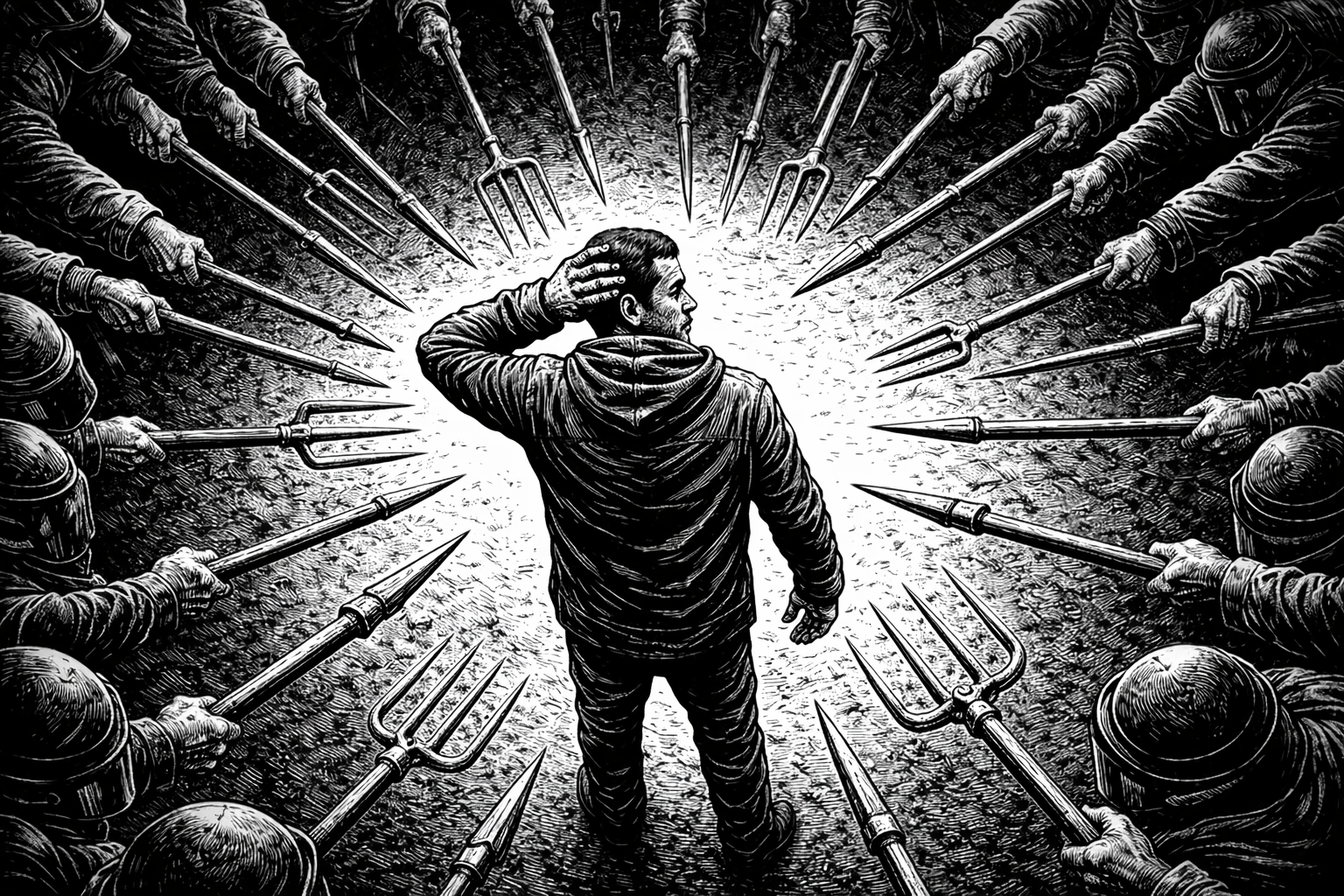
It's 3am and your phone casts a blue glow across your face. You've refreshed the same news site six times in the past hour. Nothing has changed since the last time you checked. You know this. You refresh again anyway, scrolling through the same headlines, the same terrible details, the same speculation about motive and meaning. Your heart is racing. Your jaw is clenched. You tell yourself you'll put the phone down after just one more check.
This isn't a failure of willpower. This is your brain doing exactly what it evolved to do when it perceives threat, except the threat is coming through a screen, and your brain can't tell the difference.
Your Brain Can't Tell the Difference
Your nervous system evolved over millennia to detect and respond to danger in your immediate environment: the rustle in the grass, the stranger's footsteps behind you, the smell of smoke. When it detects threat, it floods your body with cortisol and adrenaline, sharpens your attention, and keeps you vigilant until the danger passes. This system kept our ancestors alive.
But screens deliver threats from everywhere, all at once. A mass shooting 2,000 miles away triggers the same physiological response as danger outside your door. Your body doesn't distinguish between witnessing violence and being present for it. The amygdala sees the images, reads the details, and sounds the alarm: Danger. Stay alert. Keep watching. Your heart rate increases. Your muscles tense. Your body is preparing to fight or flee an enemy that isn't in the room, and it doesn't know when to stand down.
The Safety Trap
The logic makes perfect sense: if I stay informed, I can protect myself and my family. I'll know where it's safe to go, what precautions to take, when the danger has passed. I'll know what to do. So we keep checking, keep scrolling, keep searching for the piece of information that will finally let us relax.
But what we're actually doing is scanning for certainty in a situation that offers none. Each refresh, each new headline, each rehashing of events reactivates the threat response. We're not building knowledge. We're rehearsing trauma. The body experiences each exposure as a fresh alarm, and we're setting it off over and over, believing it will eventually make us feel safer. It won't. It can't. We're seeking control through information in a situation where no amount of information provides control.
When the Violence Feels Aimed at Us
Mass shootings and politically motivated violence trigger something deeper than general fear. Unlike natural disasters or accidents, these events carry intention and ideology. They're about who someone is, what they believe, what they represent. Our brains immediately begin a calculation: Am I like the victims? Do I share their identity, their politics, their visibility? Are my people being targeted? Could I be next?
This is why politically charged violence feels different. There's no clear "all clear" signal, no moment when the threat definitively ends. The danger feels ambient, woven into the fabric of daily life. We start calculating safety without even realizing it, reconsidering which places we go, what symbols we display, how visible we make ourselves in public spaces. We're not catastrophizing. We're trying to survive in a society that suddenly feels unstable. And because the threat has no clear boundary, our vigilance has no natural endpoint.
The Weight Nobody Mentions
Three days after the acute crisis, you're exhausted but can't say why. You sit at your desk unable to focus on basic tasks. Small frustrations feel insurmountable. You snap at people you love. You can't remember why you walked into a room. You think maybe you're coming down with something.
This is what accumulated exposure looks like. This isn't the first shooting, the first political crisis, the first night you've spent scrolling through horror. Your nervous system is carrying the weight of repeated activation without resolution. Threat after threat after threat, none of which your body could fight or flee. We don't have good language for this kind of injury. No one asks if you're okay from watching too much news. But your body is keeping score, and it's struggling under the load.
What Actually Helps
First, extend yourself some compassion. You're not doomscrolling because you lack discipline or strength. You're doing it because your brain is trying to protect you the only way it knows how, by staying vigilant in the face of perceived danger. The behavior makes evolutionary sense even as it harms you.
Now, harm reduction. Set specific times to check news. Fifteen minutes in the morning, fifteen in the evening. Use a timer. When it goes off, close the apps. This isn't about ignorance. It's about preventing your nervous system from living in constant activation. Between those windows, when you feel the urge to check, pause and ask: "Am I looking for new information, or am I looking for a feeling?" If nothing actionable has changed since your last check, you're seeking emotional regulation through information, and it won't work.
Your body is stuck in a threat state. Talk to it in a language it understands: movement. Walk around the block. Do twenty jumping jacks. Shake out your hands and arms like you're trying to fling water off them. Put your hands under cold running water or splash cold water on your face. These aren't distractions. They're direct signals to your autonomic nervous system that you're safe enough to move, to rest, to regulate. The thinking brain can't convince the body it's safe, but physical action can.
Talk to people you trust, but not about the news. Talk about how you're feeling. The fear, the exhaustion, the sense of unreality. Shared acknowledgment of emotional experience is fundamentally different from shared consumption of traumatic content. One discharges the nervous system. The other amplifies it.
And give yourself explicit permission to turn away. You don't have a moral obligation to bear witness when it comes at the cost of your ability to function in your actual life. You can care deeply about what's happening in the world while also protecting your nervous system. These aren't contradictory positions. You can't pour from an empty cup, and you can't engage meaningfully with the world from a state of chronic dysregulation.
The Long Road
There's no switch that returns you to normal, and that's okay. Your nervous system needs time to recalibrate, to learn that the acute danger has passed. This takes days or weeks, not hours. Be patient with your body's timeline.
Each time you feel the pull to check and choose not to, each time you close the app, set the phone in another room, go for a walk instead, you're teaching your brain something: that you can be safe without constant surveillance. That rest is possible. That the world can continue without your vigilant monitoring. These small acts of resistance accumulate. They matter.
We're allowed to be human beings with human nervous systems that need rest and recovery. We're allowed to care about the world without offering ourselves as sacrifice to an algorithm designed to keep us activated and scrolling. The vigil can end. You can put the phone down. Whatever happens next will happen whether you're watching or not, and you'll be far better equipped to respond to it if you've given your body permission to recover.